The Most British Thing About Funding
I have discovered something during this fundraising campaign.
Asking people for money is deeply uncomfortable. Not because I don't believe in the project, doubt the work in Zambia or question whether the funds will make a genuine difference, but because I am deeply British.
This means I instinctively believe that almost any awkward situation can be improved with a cup of tea, I will politely queue for almost anything, I regard rain as little more than an inconvenience to be discussed at length, and every time I share a fundraising update, mention the project or post another donation link, a small part of my brain immediately begins composing an apology.
The internal monologue is remarkably predictable. "Sorry to bother you." "Please don't feel obliged." "Only if you'd like to." "Honestly, don't worry." Preferably all in one go.
If possible, I would quite like to raise several thousand pounds while simultaneously avoiding eye contact and ensuring that nobody feels even mildly inconvenienced by the process.
I appreciate this is not generally regarded as an effective fundraising strategy.
The strange thing is that fundraising itself isn't new to me.
Over the years I've worked with charities, served as a trustee and chaired organisations that rely on the generosity of supporters. Intellectually, I understand perfectly well that worthwhile projects need funding, that people are fundamentally kind and that nobody can support something they haven't heard about.
That all makes perfect sense when you're talking about somebody else's cause.
It becomes considerably more complicated when the project involves you.
Suddenly you're no longer inviting people to support a charity. You're asking them to believe in an idea that grew out of your own life, and however irrational it may be, a polite "No thank you" feels far more personal than it has any right to.
Every fundraising update becomes faintly self-conscious. You begin wondering whether you're posting too often, whether people are quietly rolling their eyes every time Zambia appears in their newsfeed, or whether the entire internet has collectively reached the conclusion that, yes Steve, we are aware you're going to Zambia.
More than once I've written an update, stared at it for five minutes, rewritten it twice, apologised somewhere in the opening paragraph and then hovered over the "Post" button while eating a biscuit and wondering whether I should quietly delete the whole thing instead.
The reality, of course, has been nothing like the one I invented in my head.
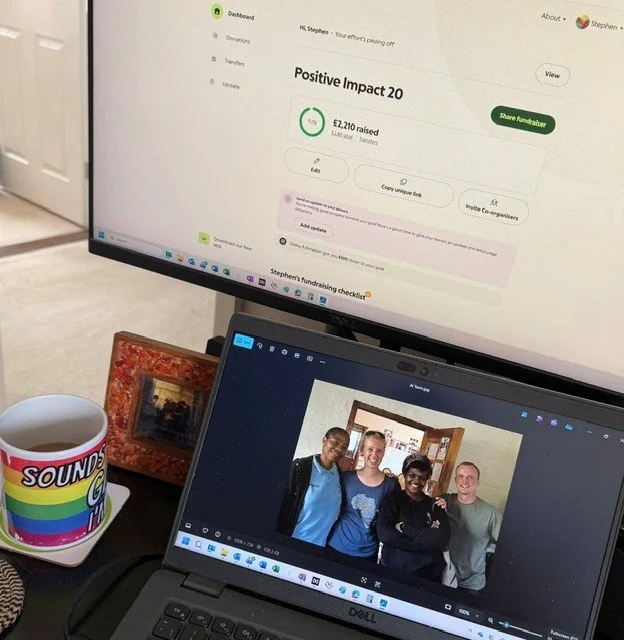
People have been extraordinarily generous, not only financially but emotionally too. Friends, family, colleagues and even people I haven't spoken to for years have donated, shared the project or simply taken the time to send an encouraging message. Those messages have often arrived on exactly the days I needed them most and, although the fundraising total has now passed £2,200, I honestly don't think the amount itself has been the biggest surprise.
The biggest surprise has been discovering how many people have recognised something of themselves in the project. Some have connected with the volunteering, others with the HIV story, and some simply like the idea of turning an anniversary into something practical. I suspect, though, that what resonates most isn't any of those things in isolation. It's the experience we all have, sooner or later, of reaching a milestone that makes us stop, look backwards for a while and ask ourselves what comes next.
Birthdays have a habit of doing that. So do retirement, loss, recovery and all those other moments that quietly divide our lives into a before and an after. They encourage us to take stock, reflect on the road we've travelled and decide, however tentatively, where we'd like the next stretch to lead.
Twenty years after my diagnosis, Positive Impact 20 became my answer to that question.
I'm not going to Zambia because I want to celebrate HIV. HIV remains an unwelcome part of my life and, despite the fact I have it fairly well managed these days, I'm under no illusion about what would happen if treatment fails, or I ease off my management of it as a long-term condition it will absolutely find the quickest route to killing me.
So I’m not going to Zambia to celebrate HIV. That would be weird.
This project came into being because I wanted to take something that once felt frightening and uncertain and turn it into something useful.
It's about gratitude. It's about recognising that twenty years ago I had no idea what my future would look like, and deciding that the best way of marking the future I've been fortunate enough to have was to try and make somebody else's a little better.
The generosity of others has reminded me that people understand that instinct far more readily than I expected.
Perhaps that's why the fundraising has been such a positive experience despite my occasional bouts of British awkwardness. Every donation has helped, of course, but so has every shared post, every encouraging message and every conversation the project has started. Together they've turned what began as a rather personal idea into something much bigger than one man travelling to Zambia.
I still experience a brief internal crisis every time I post a fundraising update.
I suspect I always will.
But I am also enormously grateful.
Even if my first instinct remains to apologise for mentioning it.
If you've donated, shared a post, sent a message or simply taken the time to read these blogs, thank you. It means more than you probably realise.
And... sorry to bother you.